



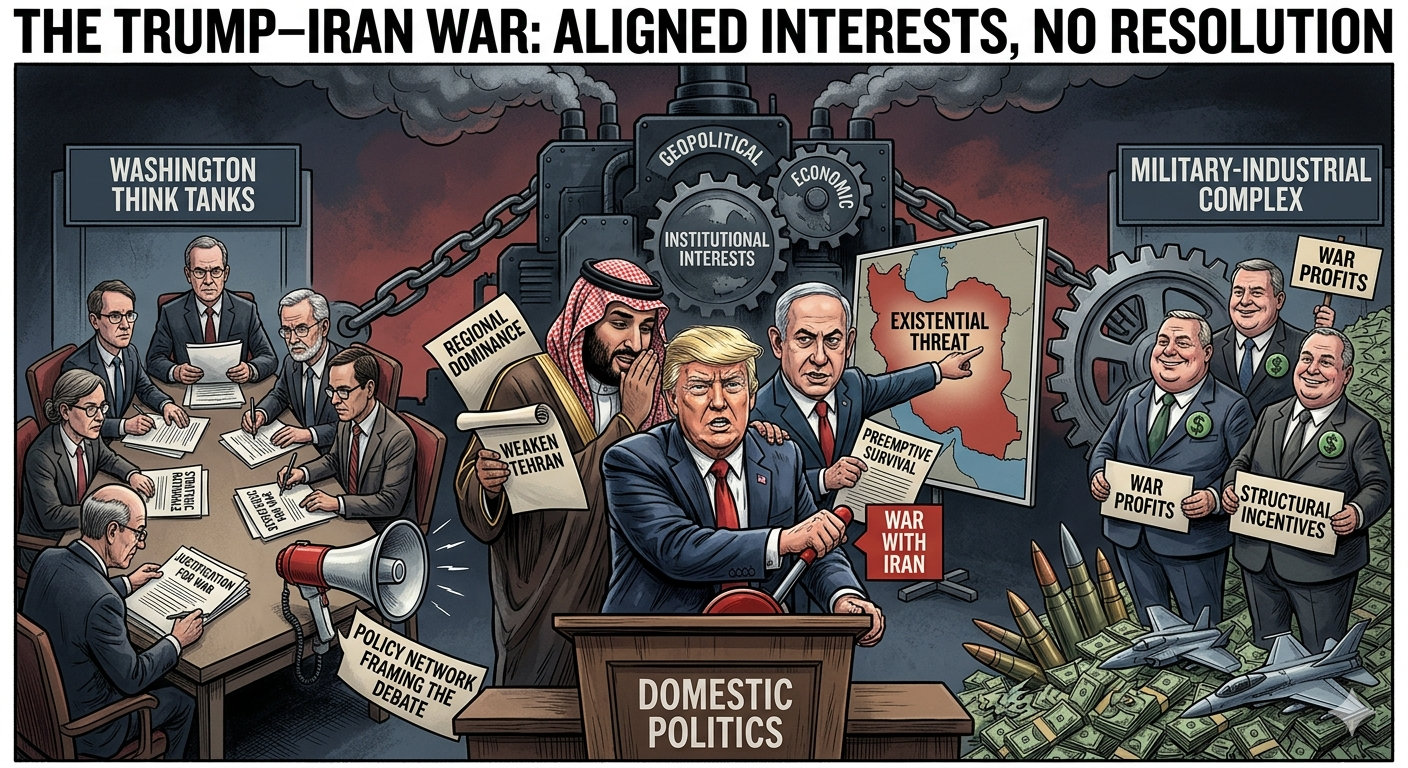
The current war between the United States and Iran did not emerge in a vacuum. While publicly framed around nuclear threats and regional security, the deeper reality is far more complex—shaped by overlapping geopolitical, economic, and institutional interests.
At the forefront are regional powers, particularly Saudi Arabia and Israel. Saudi Arabia has long viewed Iran as its primary rival for influence in the Middle East. Recent reporting shows Riyadh actively encouraging the United States to escalate the conflict, seeing it as a “historic opportunity” to weaken Tehran’s regional standing . For Saudi leadership, a diminished Iran could reshape the balance of power across the Gulf, securing its dominance in energy markets and regional politics.
Israel’s interests are even more direct. The war itself began as a joint U.S.-Israeli military operation targeting Iran’s leadership and military infrastructure . Israeli leadership has consistently framed Iran as an existential threat, particularly due to its missile capabilities and support for proxy groups. Reports indicate that Israeli influence played a decisive role in pushing for aggressive action, including high-level strikes that escalated the conflict dramatically . From Israel’s perspective, the war is not optional—it is preemptive survival strategy.
Domestically, political incentives in the United States also play a critical role. The war has unfolded amid declining approval ratings and political pressure on President Trump, with critics noting the absence of a clearly defined endgame . Historically, wartime environments can consolidate political support or shift public attention, even as polling shows widespread skepticism among Americans. The contradiction between public opposition and continued escalation highlights the tension between political strategy and democratic accountability.
Beyond governments, economic stakeholders—particularly military contractors—stand to benefit from prolonged conflict. Modern warfare is deeply intertwined with private industry, where defense spending translates directly into corporate revenue. While rarely discussed openly in official narratives, the scale of the conflict—costing tens of billions of dollars—inevitably channels significant resources into defense firms, reinforcing structural incentives for continued engagement .
Finally, think tanks and policy institutions shape the intellectual framework that justifies war. Organizations across Washington have long debated Iran’s nuclear ambitions, missile programs, and regional behavior, often advocating for more assertive policies . These institutions influence both policymakers and public discourse, helping construct the strategic rationale for intervention—even when outcomes remain uncertain.
Taken together, the Trump–Iran war reflects more than a single cause. It is the product of aligned interests: regional rivals seeking advantage, political leaders navigating domestic pressures, industries benefiting from conflict, and policy networks framing the debate. The result is a war with multiple drivers—but no clear resolution.